Multi-agent vs single agent: when orchestration helps (and when it hurts)
Start with one tool-using agent. Add multi-agent only for real role, privilege, or parallel splits you can own - decision table, checklist, and cost trade-offs.
Written by Dali
Dali is an AI agent systems studio. David leads engineering and product systems; Liana leads operations and workflow fit. We ship production agents inside tools teams already use.
David Hakobyan · LinkedIn · Dali
Direct answer
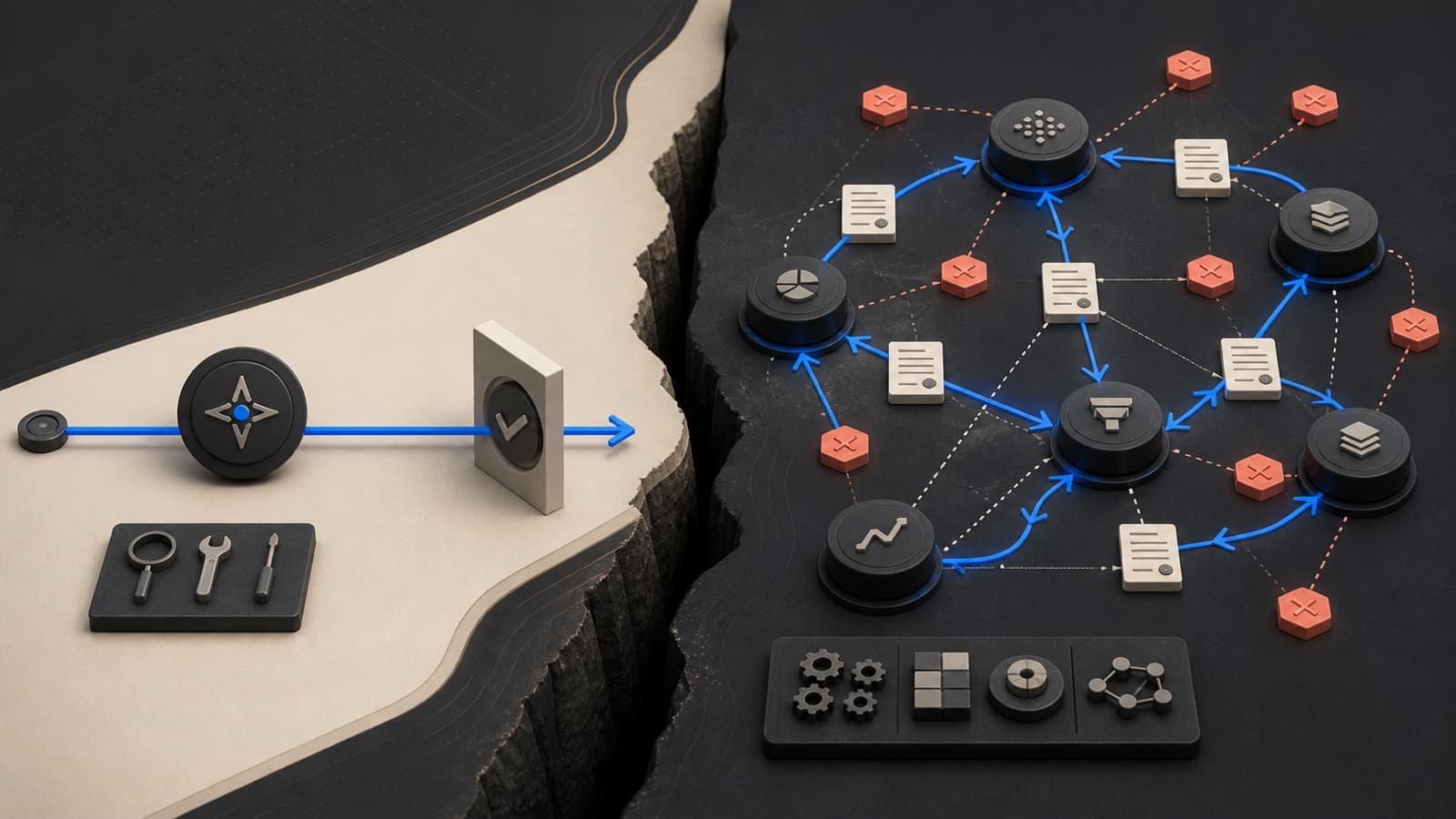
Start with one agent and clear tools for a single workflow. Add multi-agent orchestration only when roles, permissions, or handoffs are truly separate - and you can own the failure modes of the whole graph. A common failure mode is adding agents before the workflow, acceptance test, and approval owner are clear. Multi-agent is a tax you pay for real separation needs, not a quality upgrade by default.
What people mean by multi-agent (and multi-agent orchestration)
In LLM product work, multi-agent usually means a planner or coordinator plus workers, or specialized agents for research, coding, review, or other roles. Each agent often has its own context, tools, and prompt, and something must route work between them.
Multi-agent orchestration is that coordination layer: a coordinator (or router) assigns work, workers run in isolated threads or contexts, and results come back for synthesis or the next step. In platform terms, that often looks like a coordinator plus specialized or isolated workers that do not share full conversation history by default (Claude Platform multiagent orchestration).
In business ops, multi-agent often means more latency, more places to lose state at handoffs, and a larger surface to evaluate - not automatically higher quality. Classic multi-agent research describes autonomous agents with local views and decentralized control; production LLM graphs still need one operational owner for the whole path.
Single agent with tools: the default
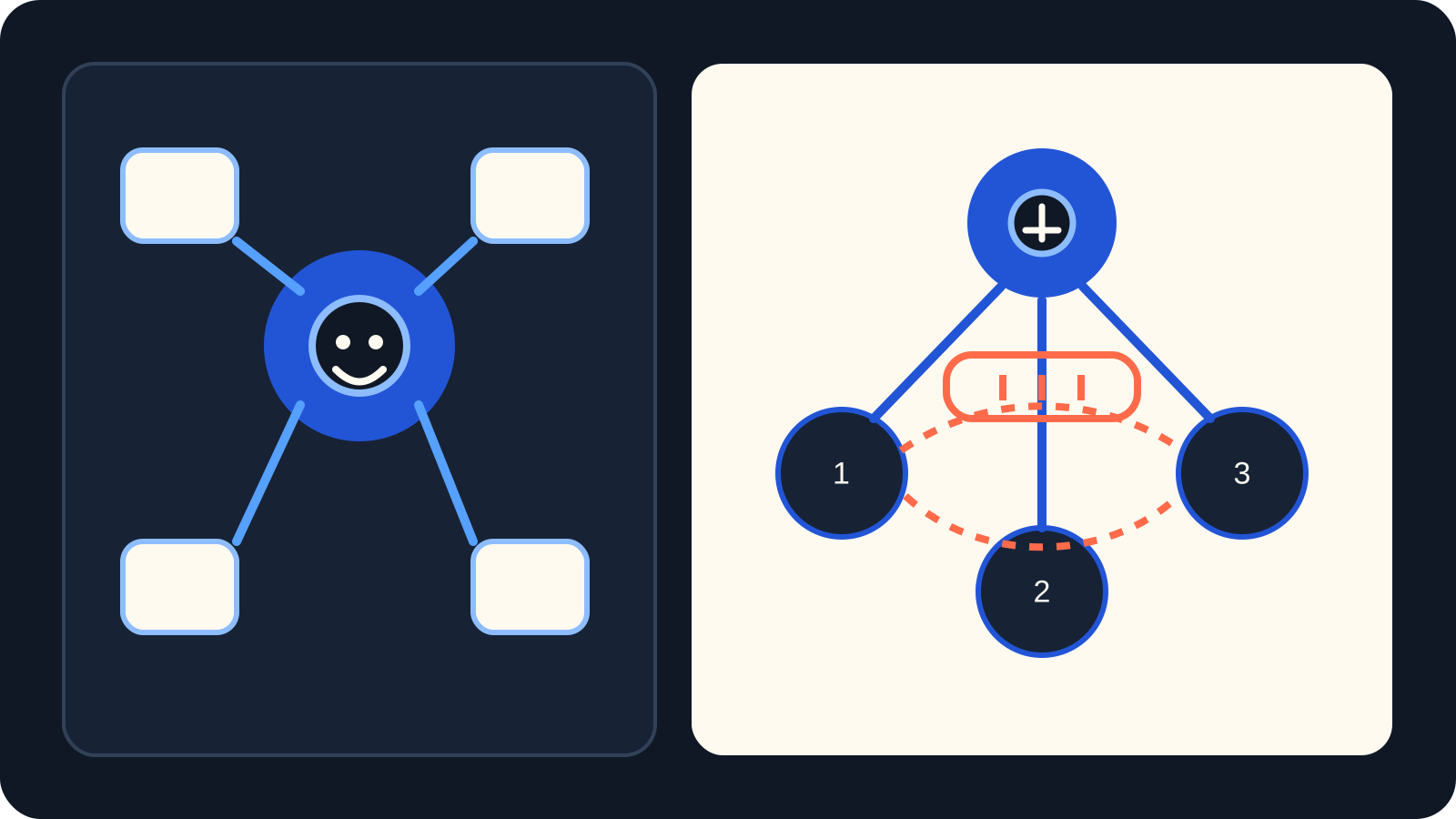
Conceptual topology: multi-agent design adds specialization, but it also adds routing, shared-state, and coordination surfaces that need ownership.
A single tool-using agent is the middle ground most teams should start with. One primary system of record, one approval owner, a short tool list, and a clear standard path usually beat a graph of agents that nobody can debug on Monday.
Many vendor and framework guides land in the same place: start with one agent that has well-designed tools before you split work across agents (LangChain on multi-agent architecture). Production trade-off writeups also treat single-agent as the simpler path for well-defined workflows without hard security boundaries (Redis: single-agent vs multi-agent).
Hypothetical ops examples that often ship better as one gated agent:
- Lead response - read the inquiry, draft a reply or CRM note, stop for human send or write when the action is customer-facing.
- Inbox triage - classify, label, and route; a human still owns escalations and irreversible replies.
- Document-to-tracker - extract fields into a sheet or ticket with validation and an approval gate before anything overwrites production data.
If the workflow fits one system of record and one person who can say yes or no to risky writes, multi-agent is usually premature. When agents are the wrong tool entirely - no stable process, no owner, no tolerance for partial automation - see when not to use AI agents.
When multi-agent can help
Multi-agent earns its keep when a single context or a single permission set is the bottleneck, not when a demo needs more boxes.
Claude's production guidance frames three justified cases: context protection (avoid polluting the main thread with bulk retrieval), parallelization (independent subtasks that can run together), and specialization (focused tools or prompts per role) (Claude: when and how to use multi-agent systems).
In ops language, that maps to:
- Hard privilege separation - a read-only research path must not share write credentials with the agent that updates CRM or finance systems.
- Breadth-first parallel work - multiple independent sources or queues that would thrash a single context if run serially.
- Stage contracts - different models or roles with an explicit handoff format (for example research summary in, approved write-out).
- Long checkpointed jobs - multi-hour work where intermediate state must survive, with a human or system gate between phases.
Enterprise adoption guidance is stricter still: start multi-agent mainly when security or compliance boundaries, multi-team knowledge ownership, or planned multi-domain growth mandate separation; otherwise prototype single-agent first (Microsoft Cloud Adoption Framework: single vs multi-agent).
Comparison table: single vs single + tools vs multi-agent
How to read this table for an ops pilot: optimize for what one team can evaluate, approve, and on-call - not for how many agents the architecture diagram shows.
| Dimension | Single agent | Single agent + tools | Multi-agent graph |
|---|---|---|---|
| Cost / tokens | Lowest for narrow Q&A | Moderate; grows with tool loops | Highest; often multiplies tokens vs one agent |
| Latency | Usually lowest | Tool round-trips dominate | Handoffs and parallel fan-out add coordination time |
| Debugging | One trace, one prompt stack | One agent plus tool logs | Fragmented across agents, contracts, and threads |
| Security boundaries | One permission set (harder least-privilege) | Still one agent; scopes tools carefully | Better isolation if roles and credentials are truly split |
| Parallel work | Weak for breadth | Sequential tool use unless tools parallelize | Strong when subtasks are independent |
| Ownership / on-call | One path, one owner | Still one owner if gates are clear | Needs an owner of the whole graph, not each agent |
| Eval surface | One acceptance test path | Tool success + outcome quality | Per-role evals plus end-to-end graph evals |
Production writeups stress the same axes - complexity, debugging, cost, and whether you need hard boundaries or specialization (Redis comparison framing).
Token and ops economics (attributed)
Token cost is not a Dali measurement; use vendor numbers as scoped observations, not universal laws.
Anthropic's engineering post on their multi-agent research system reports that a multi-agent setup with Claude Opus 4 as lead and Claude Sonnet 4 subagents outperformed single-agent Opus 4 by 90.2% on their internal research evaluation. In their data, agents typically used about 4x tokens versus chat interactions, and multi-agent systems about 15x tokens versus chats. They also note that multi-agent systems need task value high enough to pay for the performance gain, and that domains needing shared context or heavy real-time coordination (many coding tasks) fit poorly today (Anthropic: How we built our multi-agent research system).
Claude's product guidance reports that multi-agent implementations typically use about 3-10x more tokens than single-agent approaches for equivalent tasks, from duplicated context, coordination messages, and handoff summaries (Claude multi-agent guidance).
LangChain's economic framing is consistent: task value must cover token cost; build multi-agent when parallelization, large context pressure, and complex tool surfaces justify the spend (LangChain: how and when to build multi-agent systems).
Ops rule: pay the multi-agent tax only when the business value of the outcome covers tokens, latency, and the people who will own incidents.
Costs of multi-agent theater (topology and ownership)
Multi-agent theater is a demo-friendly graph that fails on Monday tickets: many agents, weak contracts, no single on-call owner of the path.
Topology and ownership costs that should kill or delay a multi-agent design:
- Handoff and state loss - each boundary can drop constraints, priorities, or partial results ("telephone game" between roles).
- Eval fragmentation - you need per-agent checks and a full-graph acceptance test; teams often ship neither.
- Unclear ownership - when a bad CRM write ships, "which agent?" is the wrong question; someone must own the graph.
- Permission blur - one shared credential bag across "specialists" erases the security reason for multi-agent.
- Duplicated work - workers re-search the same sources without clear task boundaries (a failure Anthropic called out when lead instructions were too vague).
- Verifier shortcuts - industry guidance warns that verification subagents can declare early victory after incomplete checks; only use them with concrete criteria (Claude multi-agent guidance).
These are decision-time ownership risks, not a full production failure taxonomy. For broader design against wrong-tool writes, missing gates, and silent drift, see production agent failure modes. For approval design on a single path, see human-in-the-loop AI agents.
Decision checklist: five questions
Answer these before you add a second agent.
- Are subtasks genuinely parallelizable? If every step needs the full prior context, a graph mostly adds handoff loss.
- Do separate privileges actually require isolation? If one service account can still do everything, multi-agent is costume, not security.
- Would one agent pollute its context with bulk intermediate data? If yes, a focused worker that returns a short summary may help.
- Does each role need its own eval and acceptance criteria? If you cannot define success per role, you cannot operate a graph.
- Can one person own the full graph on-call? If ownership is "the agents," do not ship multi-agent to production.
If most answers are no, stay single-agent with tools and gates.
Architecture patterns for ops (light)
Name the pattern only when it maps to an ops need - not as a framework shopping list.
- Router (queues) - classify an incoming ticket or lead and send it to the right policy or tool path without a full multi-agent conversation.
- Sequential handoff (approvals) - stage work so the next role or model unlocks only after a gate (human or system) on a fixed contract.
- Parallel workers (breadth research) - fan out independent lookups or sources, then synthesize under one owner.
- Verifier subagent (optional) - a separate checker for black-box validation when criteria are explicit and complete, not a rubber stamp.
LangChain documents related pattern families (subagents, handoffs, router, and lighter "skills" composition) and still opens with: many tasks are best as a single agent (LangChain multi-agent architecture). Pick one pattern that matches your ownership model; do not install a catalog of frameworks to feel production-ready.
Practical rule: map first, then choose topology
If you cannot draw the workflow on one page with one acceptance test, multi-agent design will not save you. Map steps, systems of record, failure cost, and human gates first - then choose topology (map workflows for AI agents).
Default path:
- Prototype a single gated agent on one standard path.
- Measure tool errors, human overrides, and end-to-end completion quality.
- Split only when security or compliance boundaries, multi-team ownership, or real parallel breadth force it - aligned with enterprise "multi only when mandated" criteria (Microsoft CAF).
- Keep one system of record for writes and one approval owner even after a split.
How Dali approaches this
Dali starts with one production path and gates, not multi-agent theater. We map the workflow, define acceptance tests, and only expand topology when privileges, parallel work, or ownership boundaries demand it. See solutions for engagement paths, and when not to use AI agents if the process is not ready for agents at all. If you are still choosing who builds (studio vs internal team), see AI agent agency vs in-house.
FAQ
No. Use them as libraries when they reduce glue code - not as a requirement for every pilot. A single tool-using agent can live in those ecosystems without a multi-agent graph.