MCP vs A2A: choose the protocol boundary, not a brand war
Compare MCP, A2A, and direct APIs by purpose, discovery, authorization, long-running work, failure modes, and the boundary each one should own.
Written by Dali
Dali is an AI agent systems studio. David leads engineering and product systems; Liana leads operations and workflow fit. We ship production agents inside tools teams already use.
David Hakobyan · LinkedIn · Dali
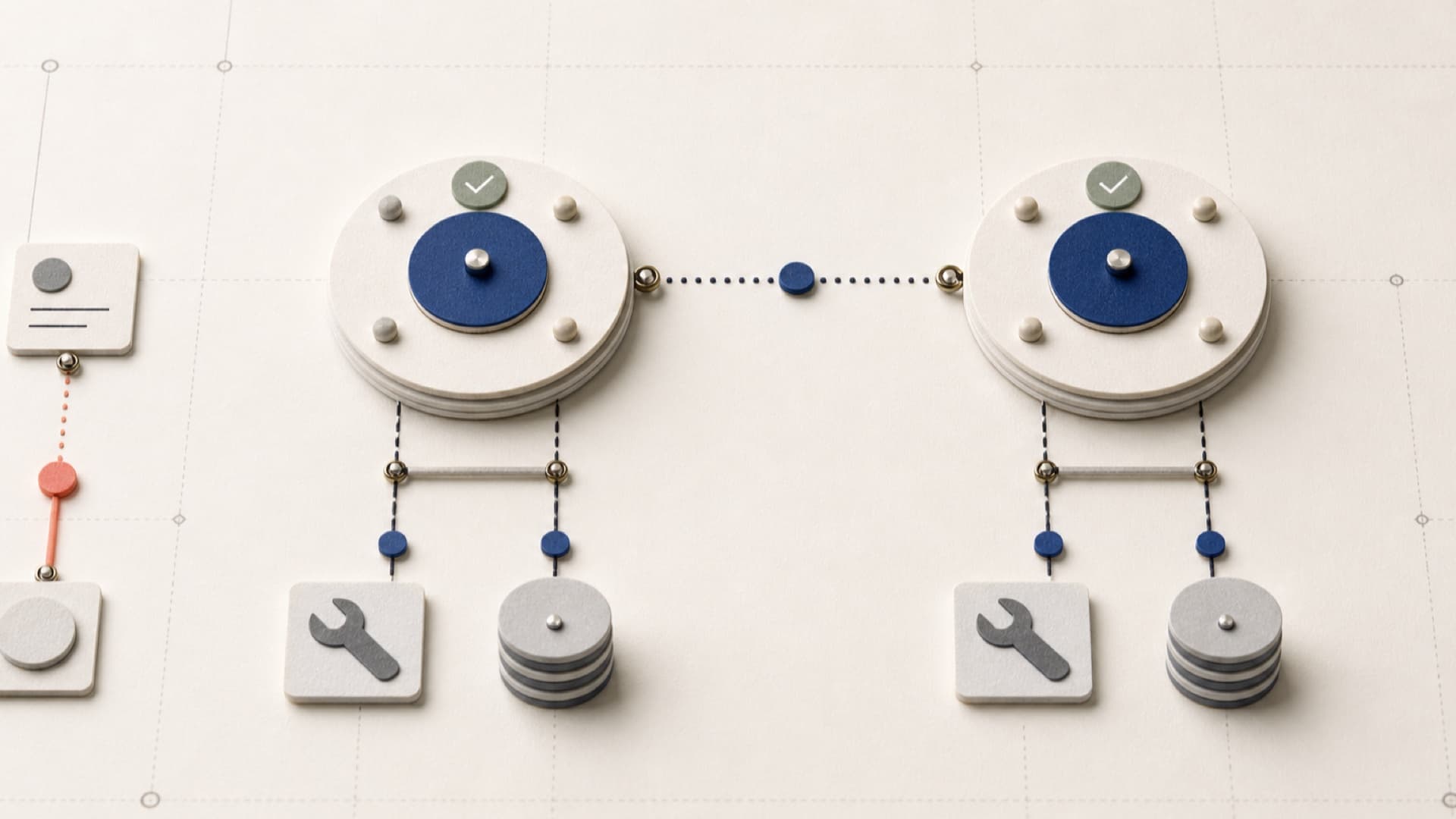
MCP standardizes how an AI application connects to tools, data sources, and related context. A2A standardizes how independent agents discover each other and collaborate on tasks without sharing internal memory or tool implementations. A direct API is often enough when one team owns one closed integration and does not need portable discovery across hosts or vendors. Many production systems will use both: A2A between agents, MCP from each agent to its tools.
These are different boundaries, not rival framework brands. Protocol details below were checked against primary documentation on 2026-08-11. Specs continue to evolve, so re-read the current MCP and A2A pages before you freeze a design.
What each protocol is for
Model Context Protocol (MCP)
MCP is an open standard for connecting AI applications to external systems such as data sources, tools, and workflows (MCP intro, docs path 2026-07-28). The architecture is host / client / server: the AI application is the host, each server connection is handled by a client, and servers expose context (MCP architecture). Servers can expose tools (callable actions), resources (contextual data), and prompts (reusable templates) (MCP architecture). The data layer uses JSON-RPC 2.0. Transports include stdio for local process communication and Streamable HTTP for remote servers, with optional Server-Sent Events for streaming (MCP architecture).
MCP does not replace your agent framework, approval policy, or evaluation system. It standardizes how context and tools are discovered and invoked across compatible clients.
Agent2Agent protocol (A2A)
A2A is an open protocol for communication and interoperability between independent, often opaque agentic applications (A2A home; A2A specification). Google announced A2A on 2025-04-09 and stated that it complements MCP, which provides tools and context to agents (Google A2A announcement). On 2025-06-23, the project moved under the Linux Foundation with major technology collaborators (Google donation post; Linux Foundation launch). When checked on 2026-08-11, the A2A docs listed latest released specification version 1.0.0 (A2A specification).
Core A2A elements include an Agent Card (JSON capability metadata), tasks (stateful units of work), messages, parts, and artifacts (A2A key concepts). Agents can interact with request/response plus polling, streaming via Server-Sent Events, and push notifications for long-running work (A2A key concepts; Google A2A announcement). Remote agents stay opaque: collaborators should not need each other's internal memory, tools, or proprietary logic (A2A home; A2A specification).
Official A2A guidance is explicit: use MCP for tools, use A2A for agents (A2A home; A2A and MCP).
Google's 2026-03-18 developer guide draws the same line: MCP for tools and data, A2A for discovery and collaboration between agents, including Agent Cards at a well-known URL such as /.well-known/agent-card.json (Developer's Guide to AI Agent Protocols).
Protocol boundary map
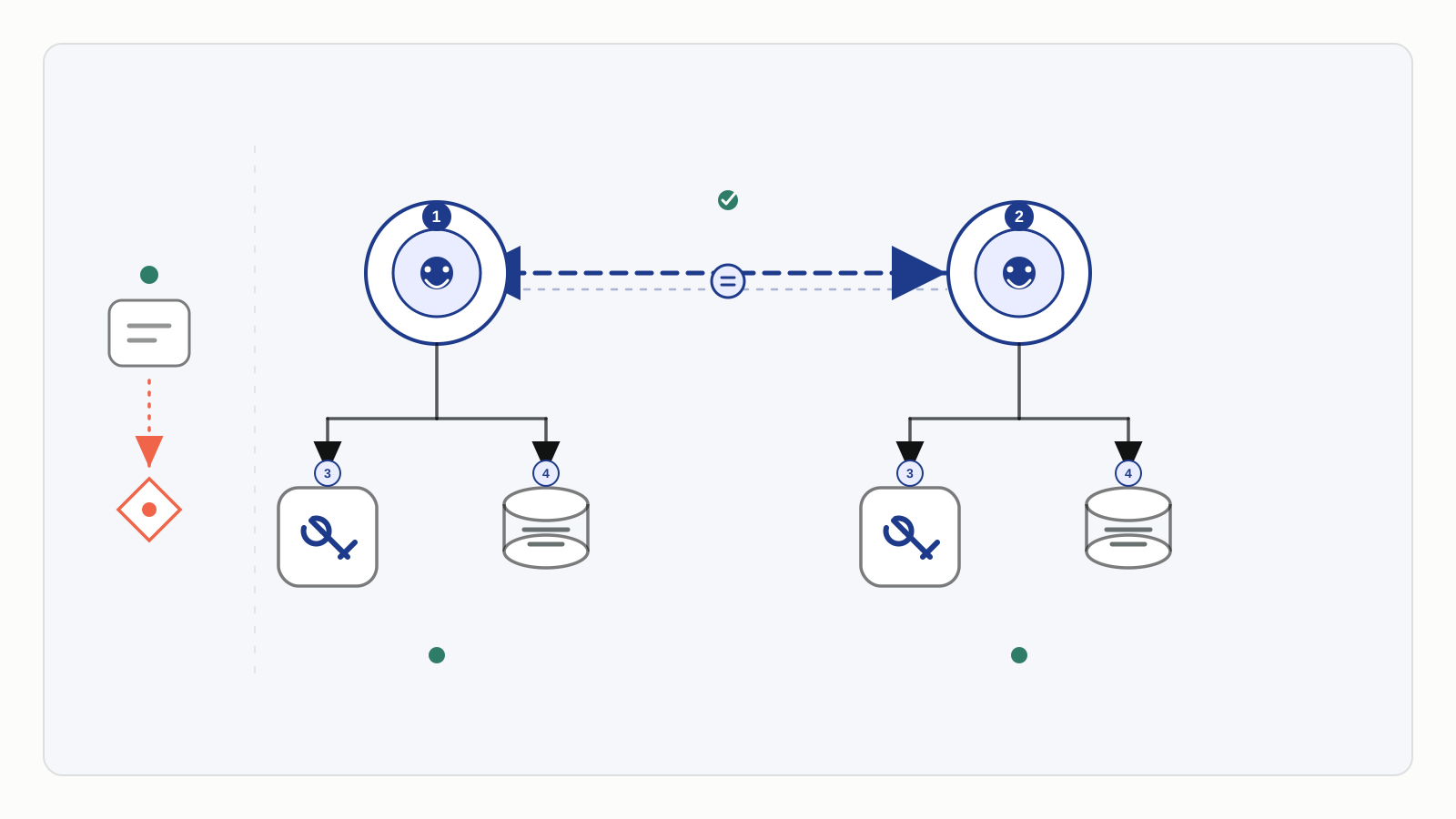
Language-neutral map: MCP is the vertical tool and data boundary; A2A is the horizontal agent-to-agent boundary; a direct API is the simple path when one application owns a closed integration.
If you are still choosing whether one agent is enough before you pick protocols, start with multi-agent vs single agent. If you are still choosing frameworks rather than connection protocols, see open frameworks and assistants.
Comparison table
How to read this table: pick the boundary that matches the participants and ownership model, not the logo that showed up in a demo.
Protocol behavior rows reflect primary documentation checked on 2026-08-11.
| Dimension | MCP | A2A | Direct API (owned integration) |
|---|---|---|---|
| Purpose | Connect an AI application to tools, data sources, and related context | Let independent agents discover, message, and collaborate on tasks | Call a specific service your app already owns |
| Participants | Host (AI app), MCP client, MCP server | User, A2A client agent, A2A server (remote agent) | Your application and the target API |
| Discovery | Server capability discovery; list tools/resources/prompts | Agent Card metadata (identity, skills, endpoint, auth requirements) | Your code and docs; no agent card standard required |
| Transport | JSON-RPC data layer; stdio and Streamable HTTP (optional SSE) | HTTP(S); JSON-RPC and other bindings; SSE streaming; optional push webhooks | Whatever the API already uses (REST, gRPC, SDK, queue) |
| Task model | Tool/resource/prompt primitives; optional Tasks extension for long-running handles | Stateful Task lifecycle with messages, artifacts, multi-turn context | Your own request/response or job model |
| Authorization boundary | Server and host must enforce auth; security guidance forbids token passthrough and stresses least privilege | Auth requirements declared on Agent Card; credentials typically via standard HTTP schemes; agents stay opaque | Your API gateway, OAuth, service accounts, and scopes |
| Streaming / long-running work | Notifications and progress utilities; Tasks extension for durable work | Designed for long-running tasks: polling, SSE streaming, push notifications | Only if you build async jobs and status endpoints |
| Failure handling | Tool/execution errors and security failure classes in guidance; client must handle missing capabilities and auth failures | Spec-defined task errors (not found, not cancelable, unsupported operation, content type, auth failures) plus terminal task states | Your HTTP codes, retries, and DLQ design |
| When not to use it | Do not use MCP as a substitute for multi-agent collaboration or as a free security control | Do not use A2A as a tool-call protocol or to wrap a simple private API | Avoid proliferating one-off APIs when many hosts need the same portable tool surface |
Sources for the protocol columns: MCP architecture, MCP security best practices, A2A key concepts, A2A and MCP, A2A specification, Google A2A announcement, Google developer guide (2026-03-18).
When a direct API is simpler
Recommendation: keep a direct API when all of the following are true.
- One application owns the integration end to end.
- The tool surface is small and stable.
- You do not need multiple AI hosts (for example desktop, IDE, chat product, and ops agent) to share the same portable server.
- You already have auth, logging, and on-call for that API.
A protocol earns its keep when discovery, reuse, or cross-team interoperability matter more than the cost of another surface to secure and monitor. Google's own protocol guide frames the practical rule as adding protocols when you need them, starting with tools and data access rather than installing every standard on day one (Developer's Guide to AI Agent Protocols).
Hypothetical example: a single support agent in your backend that only creates tickets in your own helpdesk API can stay on a private function tool. You do not need MCP or A2A for that path.
Hypothetical counterexample: the same ticket actions must be available to Claude Desktop, an internal ops agent, and a coding assistant. Then a shared MCP server (with real auth and least privilege) is a stronger fit than three bespoke wrappers.
Combined architecture: both protocols at once
Official A2A documentation describes the complementary pattern directly: an agentic app may use A2A to talk to other agents, while each agent uses MCP for its own tools and resources (A2A and MCP).
A useful mental model:
User / client agent
        |
        | A2A (tasks, messages, artifacts)
        v
  Remote specialist agent
        |
        | MCP (tools, resources)
        v
  APIs, databases, files, SaaS systems
The A2A docs' auto-repair shop scenario makes the split concrete: multi-turn conversation and supplier collaboration stay on A2A, while diagnostic scanners and manuals are MCP tools (A2A and MCP). That is the boundary decision, not a brand preference.
Remote-agent messages and tool results still compete for runtime attention. Design their retention and expiry with the context engineering lifecycle instead of dumping every payload into the model window.
For production meaning of "agent" versus demo chat, see what is a production AI agent.
Failure modes that matter more than the acronyms
Protocols do not remove operational failure. They move where failure shows up.
MCP-side failure modes
MCP security guidance treats token passthrough as an anti-pattern: servers must not accept tokens that were not issued for the MCP server itself (MCP security best practices). The same guidance covers confused deputy risks in proxy OAuth setups, SSRF during metadata discovery, session hijacking, unsafe local server startup, and over-broad scopes (MCP security best practices).
Operator consequences if you ignore that guidance:
- One over-scoped tool becomes a blast radius across every host that connected to the server.
- Audit logs lose the true client identity when tokens are forwarded blindly.
- "MCP enabled" becomes a false sense of safety.
For practical tool gates, pair this page with safe tool calling for business agents and prompt injection defenses for tool agents.
A2A-side failure modes
A2A assumes remote agents are opaque collaborators, not transparent tool functions (A2A specification). That creates different failure modes:
- Task ownership drift: a long-running task completes, fails, cancels, or waits for input, and nobody owns the terminal state.
- Capability mismatch: the Agent Card promised a skill the remote agent cannot actually fulfill under your auth or content types.
- Opaque handoff loss: constraints disappear across multi-turn messages if your contracts are weak.
- Auth theater: discovery is public-ish, but authorization for real skills is incomplete.
Recommendation: if you introduce A2A, assign an owner for the whole task path, not only for each agent binary. Topology still matters; protocol choice does not replace multi-agent ownership discipline.
Shared production failure modes
These appear whether you use MCP, A2A, both, or neither:
- Missing human gates on irreversible writes.
- No evaluation for the end-to-end workflow.
- No traces that connect model decisions to tool or remote-agent outcomes.
Design against those with production agent failure modes and agent observability.
Decision checklist
Use this as a go / no-go filter before you implement either protocol.
- What is the other party? A structured tool or data system points to MCP or a direct API. An independent agent with its own reasoning and skills points to A2A.
- Who owns auth and blast radius? If you cannot name the authorization boundary, do not expose the surface.
- Do multiple hosts need the same tools? Yes favors MCP. No favors a private API or in-process tools.
- Do agents from different teams or vendors need to collaborate without sharing internals? Yes favors A2A. No favors a single agent with tools.
- Is the work long-running with status, artifacts, or human wait states? A2A is designed for that class of task. MCP can support long-running work via extensions and notifications, but it is still a tool/context protocol, not a peer agent mesh.
- Can you observe and cancel the work? If you cannot log, revoke, or stop the path, the protocol choice is premature.
- Is a simpler path available? Prefer the thinnest boundary that meets the requirement.
FAQ
No, not according to the primary protocol literature. Google's A2A launch and the official A2A docs both position A2A as complementary to MCP ([Google A2A announcement](https://developers.googleblog.com/en/a2a-a-new-era-of-agent-interoperability/); [A2A and MCP](https://a2a-protocol.org/latest/topics/a2a-and-mcp/)).