AI voice agents for business: production pilot guide
Decide whether an AI voice-agent pilot fits, then define architecture, latency, tools, consent, escalation, evaluation, and cost drivers before scaling.
Written by Dali
Dali is an AI agent systems studio. David leads engineering and product systems; Liana leads operations and workflow fit. We ship production agents inside tools teams already use.
David Hakobyan · LinkedIn · Dali
A production AI voice agent for business is a good pilot when one high-volume phone workflow is narrow, reversible enough to gate, and already owned by a human process with clear success criteria.
It is a poor first project when the real problem is missing SOPs, chaotic calendars, unclear identity, or a desire to "replace the call center" without measurement.
Production for voice means more than a natural-sounding demo. It means a chosen audio architecture, turn-taking and interruption behavior, scoped tools, identity rules, recording and consent policy, human escalation, fallback when the stack fails, and an evaluation plan before traffic grows.
Voice agents do not replace a call-center team. At best they take a defined slice of routine work, prepare context for humans, and escalate cleanly when the case leaves policy.
If you need the channel-agnostic definition of production agents first, start with what a production AI agent is and production AI agents for business. This article is the voice-specific pilot and control design.
When a voice pilot fits
Recommendation: start only when all of the following are true.
- You can name one workflow end to end (for example inbound hours and routing, appointment intake with confirmation only, order-status lookup, or post-visit FAQ).
- A human process already exists, even if it is messy.
- Wrong answers have a known recovery path (reschedule, refund review, supervisor call-back).
- You can record or reconstruct turns for review without inventing a compliance program on the go-live day.
- Someone owns pauses, model or prompt changes, and vendor incidents.
Wait or use another channel when:
- the call is mostly negotiation, crisis, medical judgment, or legal commitment;
- tools of record (calendar, CRM, inventory) are not trustworthy;
- no one will review transcripts or warm transfers;
- outbound calling is the first idea and consent is unsolved.
Text channels often remain better for asynchronous work. See WhatsApp, Slack, and email channel rules and when not to use AI agents yet.
Map the workflow before you pick a voice vendor. The method in how to map workflows for AI agents still applies: steps, tools, failure cost, and human gates.
Architecture: speech-to-speech or chained pipeline
Primary platform docs describe two legitimate voice architectures (OpenAI voice agents).
| Architecture | How it works | Strong fit | Trade-off |
|---|---|---|---|
| Speech-to-speech live audio session | Model takes live audio in and out inside a realtime session | Natural turn-taking, barge-in, low first-audio latency, realtime tool use | Intermediate text is less explicit; policy checks and durable transcripts need deliberate design |
| Chained STT → text agent → TTS | App owns transcription, reasoning, and speech synthesis as separate stages | Approval-heavy flows, replaceable STT/TTS, stronger intermediate audit | Extra hops can add latency; turn-taking must be engineered across components |
OpenAI's guide treats speech-to-speech as the usual starting point when the interaction should feel conversational and immediate, including barge-in and realtime tools. It treats the chained path as better when you need explicit control over intermediate text, reuse of an existing text agent, or durable stage boundaries.
Deepgram's voice agent documentation similarly frames a pipeline that unifies listening, thinking, and speaking while still exposing STT, LLM, TTS, endpointing, and audio format configuration (Deepgram Voice Agent).
Recommendation: choose architecture for control and review needs first, not for demo polish. Many production teams use speech-to-speech for conversational feel and still write business side effects through a server-side tool layer with hard allowlists.
Realtime sessions keep a connection open for audio, events, tool calls, and session state (OpenAI Realtime). That is infrastructure, not a finished business system.
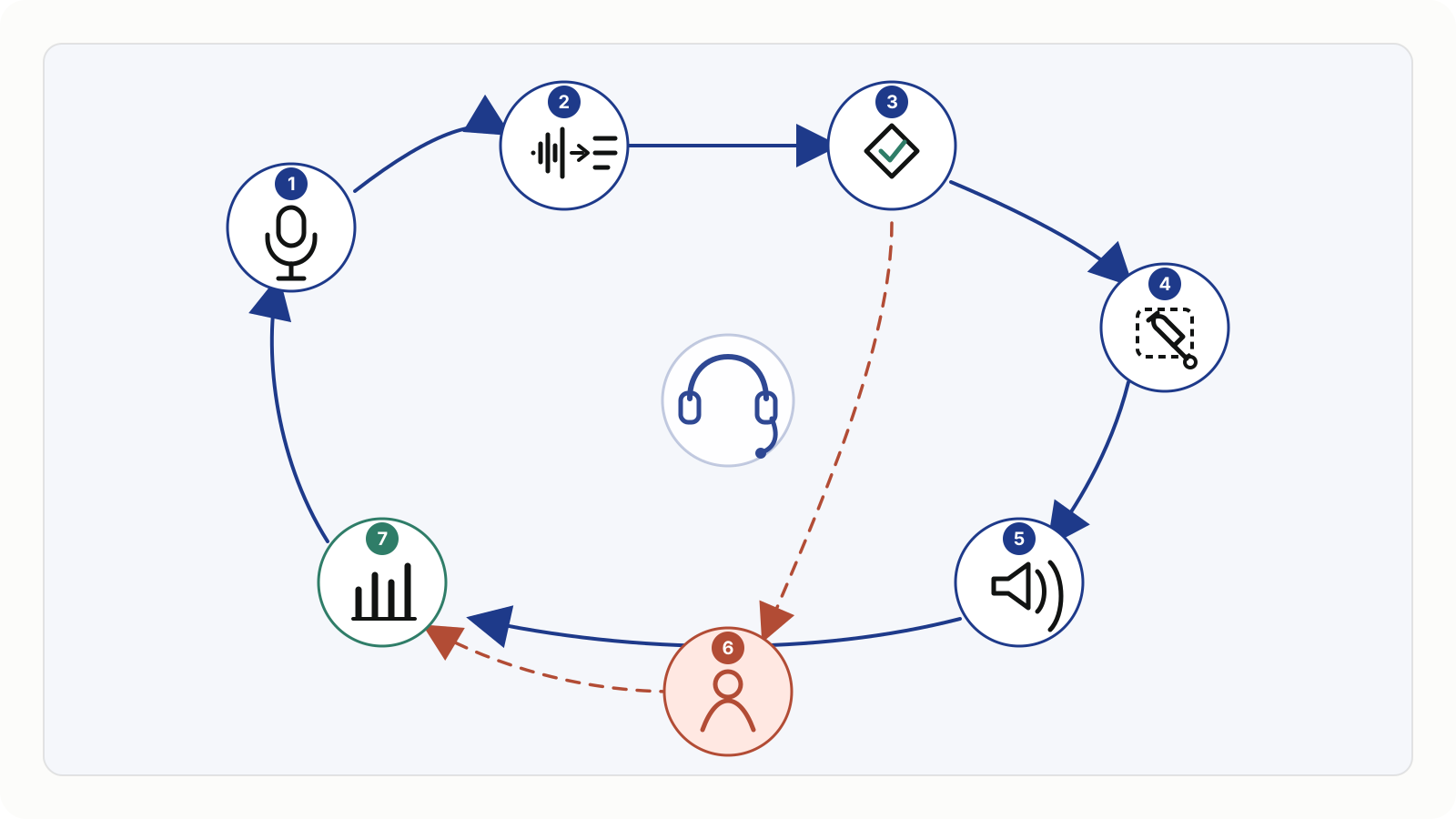
A production voice agent is a closed control loop: capture audio, understand the turn, decide under policy, act only with allowed tools, speak, then escalate or log for review. If any box is missing, treat the system as a demo.
Workflow decision table
The table below is a recommended starting map, not a maturity standard and not a report of client outcomes. Set autonomy from consequence of error, reversibility, and your ability to detect failure.
| Workflow type | Starting autonomy | Required tools | Human handoff | Evaluation evidence |
|---|---|---|---|---|
| Inbound hours, location, and FAQ | Answer only from approved knowledge; no side effects | Knowledge retrieval, business-hours rules | Escalate when source is missing, conflicting, or caller insists on a person | Supported-answer rate, citation validity, forced-escalation rate |
| Appointment intake (capture + propose) | Collect slots preference; human or system confirms write | Calendar read, qualification fields, CRM draft note | Confirm booking, cancel, or reschedule with a human or gated write | Double-book incidents, missing-field rate, confirmation latency |
| Order or ticket status | Read-only lookup after identity check | Auth method, order/ticket API (read) | Escalate on mismatch, multiple matches, or account risk flags | Auth failure rate, lookup accuracy, stale-data incidents |
| Lead qualification on inbound calls | Ask structured questions; create CRM lead; no outbound promises | CRM create/update (scoped), routing rules | Transfer sales-ready leads with full context package | Field completeness, bad-lead rate, transfer acceptance |
| Payment or refund discussion | Draft explanation only; never execute money moves | Policy docs, account read | Human approves any credit, refund, or plan change | Unauthorized-action attempts blocked, approval rejections, incident count |
| Outbound reminder or notice (where lawful) | Strict script + tool calls; stop on any dispute | Consent store, calendar/CRM read, dialer controls | Immediate transfer or callback on complaint or complex reply | Consent proof coverage, opt-out handling, complaint rate |
| Warm transfer after partial resolution | Agent collects context, then bridges | Queue / softphone transfer, case note write | Human owns remaining resolution | Handoff completeness, bounce-back rate, time to human speech |
Hypothetical example: a multi-location clinic might pilot appointment intake with calendar read and human confirmation before any write, not full auto-booking across providers.
For text-first support patterns that can later share knowledge and gates with voice, see AI agent use cases for customer support.
Latency, turn-taking, interruption, and transcription
Latency
Voice feels broken when silence stretches after the caller finishes a thought. Primary product guidance stresses low first-audio latency for conversational sessions and suggests balancing reasoning effort against responsiveness (OpenAI documents adjustable reasoning levels with low as a default for many realtime voice uses) (OpenAI voice models announcement).
Recommendation: measure end-to-end time from end of user speech to first audible agent audio in your stack, on real phone or browser paths. Do not import someone else's millisecond marketing target as a standard. Also measure tool-call wait: if the agent must look up a record, it should say so and stay interruptible where safe.
Turn-taking and interruption
Turn detection decides when the user finished speaking and when mid-response speech should stop the agent (LiveKit turns overview). Platforms offer different modes: model-based end-of-turn, server VAD on realtime models, VAD-only, STT endpointing, or manual push-to-talk.
Interruption (barge-in) is not a nice-to-have. LiveKit documents pausing agent speech on user speech, truncating history to what the user actually heard, adaptive handling that aims to separate true interruptions from backchannels, and configurable recovery from false interruptions. Google Dialogflow CX documents barge-in so callers can interrupt response audio; when interrupted, the agent stops sending audio and processes the next input (Dialogflow CX advanced speech).
Recommendation for pilots:
- enable barge-in for conversational FAQs and intake;
- tune endpointing carefully on noisy phone audio (LiveKit notes higher VAD thresholds as a telephony-oriented pattern for noisy lines);
- define behavior when the user interrupts mid-tool-call (cancel, finish in background, or resume);
- log interruption events so you can fix false cutoffs.
Transcription
Even in speech-to-speech systems, you usually need a transcript for review, QA, and CRM notes. Chained pipelines make the transcript a first-class stage. Speech-to-speech systems need an explicit capture path for the same reason.
Recommendation: store a redacted transcript, confidence or uncertainty signals if available, language, and timestamps aligned to tool calls. Do not treat the transcript as legal truth without a retention and access policy.
Identity, tools, and permissions
A voice agent that can "do anything the support login can do" is not production-ready.
Core agent guidance still applies: models, tools, and instructions, with human intervention after failure thresholds and before high-risk actions (OpenAI practical guide to building agents). Voice agent docs explicitly attach tools, handoffs, guardrails, and human review the same way as text agents (OpenAI voice agents, guardrails and human review).
Recommendation:
- verify identity before account-specific answers (caller ID alone is weak for high-risk actions);
- use least-privilege tool scopes and allowlists (safe tool calling for business agents);
- separate read tools from write tools;
- require human approval for money movement, legal commitments, account takeover recovery, and irreversible cancellations (human-in-the-loop AI agents);
- give the agent a machine identity with rotation, audit, and kill-switch, not a shared employee password.
Spoken tool use should stay transparent when waits happen. OpenAI's realtime voice product notes describe parallel tool calls and audible status phrases such as checking a calendar while work continues (OpenAI voice models announcement). Treat that as a UX pattern, not proof that every vendor implements it well.
Buy, build, or bring a production partner
Use a managed voice product when the workflow fits its native integrations, approval model, transcript controls, and handoff behavior without custom orchestration. This is often the fastest fit for a narrow receptionist, routing, or FAQ pilot where the platform already exposes the required phone and CRM paths.
Build a custom orchestration layer when identity, tool policy, business rules, deployment boundary, or evaluation must differ materially from the product defaults. Custom work is justified by control requirements, not by a desire to recreate telephony plumbing.
Bring a production partner when the hard part spans workflow design, tool permissions, consent and retention decisions, failure testing, and rollout ownership across several systems. The partner should leave behind observable evidence and an operating handoff, not only a convincing voice demo.
Cost drivers to request before signing
Do not compare vendors on a single advertised per-minute number. Request the complete cost model for telephony transport, speech recognition, speech generation, model inference, concurrent sessions, number rental, recordings and transcripts, tool calls, human transfer, QA review, support, and minimum commitments.
Also model failed calls and human cleanup. A cheaper minute can cost more when latency causes repeat calls, transfers lose context, or supervisors must reconstruct every case.
For partner evaluation beyond the voice channel, use how to choose a production AI agent partner.
Recording, consent, and outbound rules
This section is not legal advice and is not universal. Rules differ by country, U.S. state, industry, and call type. Involve counsel for your jurisdictions before recording or placing AI voice outbound calls.
Recording
Telephony providers warn that recording requires compliance with consent laws, and that practices differ across jurisdictions (examples include California's Invasion of Privacy Act and similar laws elsewhere) (Twilio Record legal notice). Twilio's compliance article states it is best practice to comply with the strictest applicable consent rules and to obtain consent from all participants before recording (Twilio legal considerations for recording).
Recommendation:
- decide whether you record audio, store transcripts, or both;
- disclose recording and AI assistance where required or where brand policy demands it;
- store retention period, access roles, and deletion process before pilot traffic;
- redact payment data and government IDs from logs where possible.
Outbound AI voice (U.S. TCPA example)
In the United States, the FCC's Declaratory Ruling FCC 24-17 (released February 8, 2024) confirms that TCPA restrictions on "artificial or prerecorded voice" encompass AI technologies that generate human voices, so covered calls generally require prior express consent of the called party absent an emergency purpose or exemption (FCC 24-17 PDF).
That ruling is a U.S. TCPA point. Other countries regulate automated and marketing calls under different statutes. Do not copy a U.S. consent form into another market and call it done.
Recommendation: treat outbound AI voice as a separate pilot from inbound FAQ, with a consent ledger, quiet hours, opt-out handling, and a hard stop on disputed or angry replies.
Escalation, fallback, and warm transfer
Production voice design assumes the agent will fail in public.
Design three exits:
- Policy escalation - the request is out of scope or high risk.
- Confidence escalation - transcription, identity, or retrieval is too weak to continue safely.
- System fallback - model, STT, TTS, or telephony provider errors; queue to human or leave a structured callback.
Warm transfer should pass a compact package: verified identity state, intent, tools already tried, transcript summary, and forbidden next actions. Chat-style handoff patterns still help; see the principles in human handoff design even though the transport is phone rather than Telegram.
Recommendation: never end a failed call with silence or an infinite loop of "I did not catch that." Offer a human path, a callback, or a clear stop.
Observability and pilot measurement
NIST's AI Risk Management Framework is voluntary, but it is useful language for operators: define roles for human-AI configurations, measure and monitor systems, and remember that people may over-trust automated behavior (NIST AI RMF 1.0, NIST AI RMF hub).
Voice-specific signals to log:
- session and call IDs;
- turn timestamps and interruption events;
- transcript plus redaction flags;
- tool name, arguments (redacted), result status;
- escalation reason codes;
- transfer outcome;
- model, prompt, and tool schema versions;
- provider error codes.
For the general production logging schema, see agent observability: logs, traces, and storage.
Pilot scorecard (define your own thresholds)
| Measure | Why it matters | How to review |
|---|---|---|
| Task completion on the scoped workflow | Did the pilot job finish without hidden human cleanup? | Sampled calls + system truth |
| Forced escalation rate | Is the agent too cautious, too bold, or well gated? | Reason-code histogram |
| Handoff package completeness | Can a human continue without re-interrogating the caller? | Supervisor checklist |
| Unauthorized tool attempts blocked | Are permissions real? | Security / tool audit log |
| Interruption quality | Does barge-in cut too late, too early, or on noise? | Tagged interruption samples |
| Identity failures | Wrong-person risk | Mismatch and multi-match cases |
| Consent / disclosure defects | Recording and outbound compliance | Legal + ops dual review |
| Time to first audio / time to resolution | Latency and process drag | Instrumentation, not anecdotes |
Run a golden set of call scripts and adversarial cases before go-live. Use the method in how to evaluate AI agents before go-live. Prefer shadow or limited canary traffic before full DID (phone number) cutover (shadow mode and canary for AI agents).
Do not publish vanity "containment" percentages without defining what containment means and who cleaned up after the call.
Failure modes
These recur in production voice systems. For a broader agent failure catalog, see production agent failure modes.
| Failure mode | What the caller experiences | Design control |
|---|---|---|
| Demo-grade latency | Long dead air after every turn | Measure end-to-end; reduce reasoning on simple turns; stream status speech |
| No barge-in | Caller talks over a monologue that keeps going | Enable interruption; clear playout buffers; truncate history to heard audio |
| False interruptions | Agent stops on noise or "uh-huh" | Adaptive interruption or thresholds; resume-on-false-interruption policy |
| Hallucinated policy | Confident wrong hours, price, or medical advice | Ground answers; refuse without sources; escalate |
| Over-privileged tools | Agent books, refunds, or changes account state by accident | Allowlists, write gates, human approval |
| Weak identity | Account data read for the wrong person | Step-up verification before sensitive reads |
| Silent transfer failure | "Please hold" forever | Monitor queue state; announce fallback; offer callback |
| Recording without consent path | Legal and brand risk | Jurisdiction review; disclosure; retention policy |
| Outbound without consent | Regulatory and complaint risk | Consent ledger; TCPA-class checks where applicable |
| Unowned prompts | Behavior drifts after "small" edits | Version prompts and tools; canary; named owner |
Anti-patterns:
- buying a voice vendor because the demo was funny, without a workflow map;
- starting with full auto-booking and payments;
- claiming the system will replace the call-center team;
- skipping transcript review because "the voice sounded good";
- one shared admin credential for every tool.
FAQ
Either can work. Speech-to-speech is usually better for natural interruption and low first-audio latency. Chained STT-LLM-TTS is often better when you need hard intermediate checks, durable text stages, or reuse of an existing text agent ([OpenAI voice agents](https://developers.openai.com/api/docs/guides/voice-agents)). Pick from control needs, not from marketing labels.