AI Agents for Customer Service: 7 Use Cases and a Pilot Plan
Choose practical AI agent use cases for customer service, set human approval boundaries, design handoffs, and measure a safe support pilot.
Written by Dali
Dali is an AI agent systems studio. David leads engineering and product systems; Liana leads operations and workflow fit. We ship production agents inside tools teams already use.
David Hakobyan · LinkedIn · Dali
Direct answer
The best first use cases for AI agents in customer service are ticket triage, grounded answers from approved sources, reply drafting, conversation summaries, context collection before handoff, and low-risk account lookups.
Start with work that is repetitive, language-heavy, easy to verify, and reversible. Keep refunds, cancellations, security changes, legal commitments, and other high-impact actions behind a human approval gate until real evaluation data supports a different policy.
The goal is not to remove the support team from the loop. It is to give customers faster help on standard cases and give human agents a cleaner, better-informed queue for everything else.
Seven practical customer service use cases
| Use case | What the agent does | Recommended starting autonomy | Evidence to monitor |
|---|---|---|---|
| 1. Ticket triage | Detects intent, urgency, language, product area, and routing attributes | Acts on routing, with sampled review | Routing accuracy, reassignment rate, queue age |
| 2. Grounded answers | Retrieves approved support content and answers with source links | Answers low-risk intents; escalates when sources are missing or conflicting | Supported-answer rate, citation validity, reopen rate |
| 3. Reply drafts | Produces a draft inside the agent workspace | Human sends | Edit distance, reviewer acceptance, handle time |
| 4. Conversation summaries | Compresses the thread, actions tried, customer state, and open question | Writes an internal note | Missing-critical-fact rate, human correction rate |
| 5. Handoff preparation | Collects required fields and routes the case with context | Acts on intake and routing | Handoff completeness, bounce rate, time to human response |
| 6. Read-only account lookup | Retrieves order, subscription, delivery, or entitlement state | Answers under scoped read permission | Lookup accuracy, permission errors, stale-data incidents |
| 7. Gated procedures | Proposes a credit, cancellation, reschedule, or account change | Human approves the action | Approval rate, rejection reason, incident count, rollback use |
The table describes a recommended rollout pattern, not a universal maturity model. Each company should set autonomy from the consequence of a wrong action, the reversibility of the action, and its ability to detect failure.
1. Ticket triage and routing
Triage is a strong first use case because the agent can improve queue flow without speaking for the company or changing customer state.
Useful outputs include:
- intent and sub-intent;
- product area;
- language;
- sentiment or urgency signal;
- customer tier or region from trusted account data;
- target team;
- reason for the route.
Do not route from model output alone when a deterministic rule is available. For example, an account's plan, country, or contract tier should come from the system of record. The model is better used for the unstructured part, such as understanding what the customer is asking.
A good triage trace lets a reviewer see the original message, extracted attributes, deterministic data, chosen route, and confidence or fallback reason.
2. Grounded answers from approved knowledge
A support agent should answer from a controlled source set, not from general model memory or an unrestricted web search.
The source set may include:
- help-center articles;
- current pricing and plan rules;
- return, refund, and cancellation policies;
- product release notes;
- service-status information;
- account-specific data that the customer is authorized to see;
- internal resolution procedures.
The agent needs a defined response when the source is missing, stale, or contradictory. That response should be to ask a clarifying question or escalate, not to fill the gap with a plausible policy.
Current Intercom documentation, for example, treats selected knowledge sources, answer inspection, triage, and human handoff as distinct product capabilities (Fin AI Agent explained, knowledge sources). This is one product implementation of a broader design principle: the business owns the corpus and the agent must expose enough evidence to review its use.
For a detailed source-ownership checklist, see knowledge base for a site AI assistant.
3. Reply drafting for human agents
Drafting is often the safest way to introduce generative output into an existing support operation.
The AI agent can retrieve the relevant policy, summarize the customer context, and prepare a response in the team's tone. The human agent checks the facts and sends it.
Drafting is especially useful when:
- responses require several source lookups;
- agents repeatedly rewrite the same policy in different contexts;
- language quality or localization slows the queue;
- a case is sensitive enough to require judgment but structured enough to prepare.
Measure more than whether reviewers click "accept." Track material corrections, missing facts, policy mistakes, and whether the reviewer had to perform the same research again.
4. Conversation summaries and internal notes
Long threads create work before the human can even begin resolving the issue.
A useful handoff summary should contain:
- the customer's current goal;
- verified account or order context;
- what the customer already tried;
- answers or actions already given;
- the source or policy used;
- the unresolved decision;
- urgency and promised follow-up, if any.
Avoid summaries that only restate sentiment. The receiving agent needs decision context and evidence.
5. Intake before human handoff
An AI agent can collect missing information before routing a case.
For a damaged delivery, that might include the order ID, item, delivery date, damage type, and image attachment. For a technical issue, it might include product version, environment, reproduction steps, and the exact error.
The intake must remain proportionate. Do not make an upset customer repeat information that already exists in the conversation or account record.
The handoff itself is a contract between the AI path and the human queue. At minimum, pass:
customer_goal
verified_identity_and_account_context
intent_and_route_reason
sources_used
actions_already_attempted
open_question_or_required_decision
risk_or_policy_flags
conversation_summary
Intercom's current escalation documentation shows a concrete version of this separation: rules or guidance decide when escalation happens, while workflows decide what happens after the escalation (Intercom escalation guidance and rules).
6. Read-only account and order lookup
Support becomes more useful when the agent can retrieve current customer state.
Start with read-only tools that return a small, typed result such as:
- order status;
- delivery estimate;
- subscription plan;
- invoice availability;
- service entitlement;
- known incident status.
Scope the credential to exactly the records and fields required. Filter results server-side so a model cannot request another customer's data by changing an identifier.
Log which tool was called and which policy allowed the result to be shown, but do not copy unnecessary personal data into model traces.
7. Gated account actions and procedures
An agent can eventually participate in procedures that change customer state. The first release should separate proposing an action from executing it.
| Action | Starting policy | Why |
|---|---|---|
| Resend a public help article | Agent may act | Low impact and reversible |
| Update a non-sensitive preference | Agent may propose or act under policy | Limited scope, but identity still matters |
| Apply a small policy-defined credit | Agent proposes; human approves | Financial effect and policy exceptions |
| Cancel a subscription | Human approves | Revenue impact, retention context, and possible irreversibility |
| Issue a refund | Human approves | Money movement and fraud risk |
| Change email, MFA, or account ownership | Specialized human path | Account-takeover risk |
| Make a legal or regulatory commitment | Qualified human path | High stakes and jurisdiction-specific judgment |
OpenAI's agent-building guide recommends human intervention when failure thresholds are exceeded and before high-risk actions such as cancellations, large refunds, or payments (OpenAI practical guide).
Some support platforms now expose the same pattern directly. Intercom documents a procedure step that pauses for human review on sensitive or high-risk decisions (human-in-the-loop approvals).
For the full control model, read human-in-the-loop AI agents explained.
A production-shaped support flow
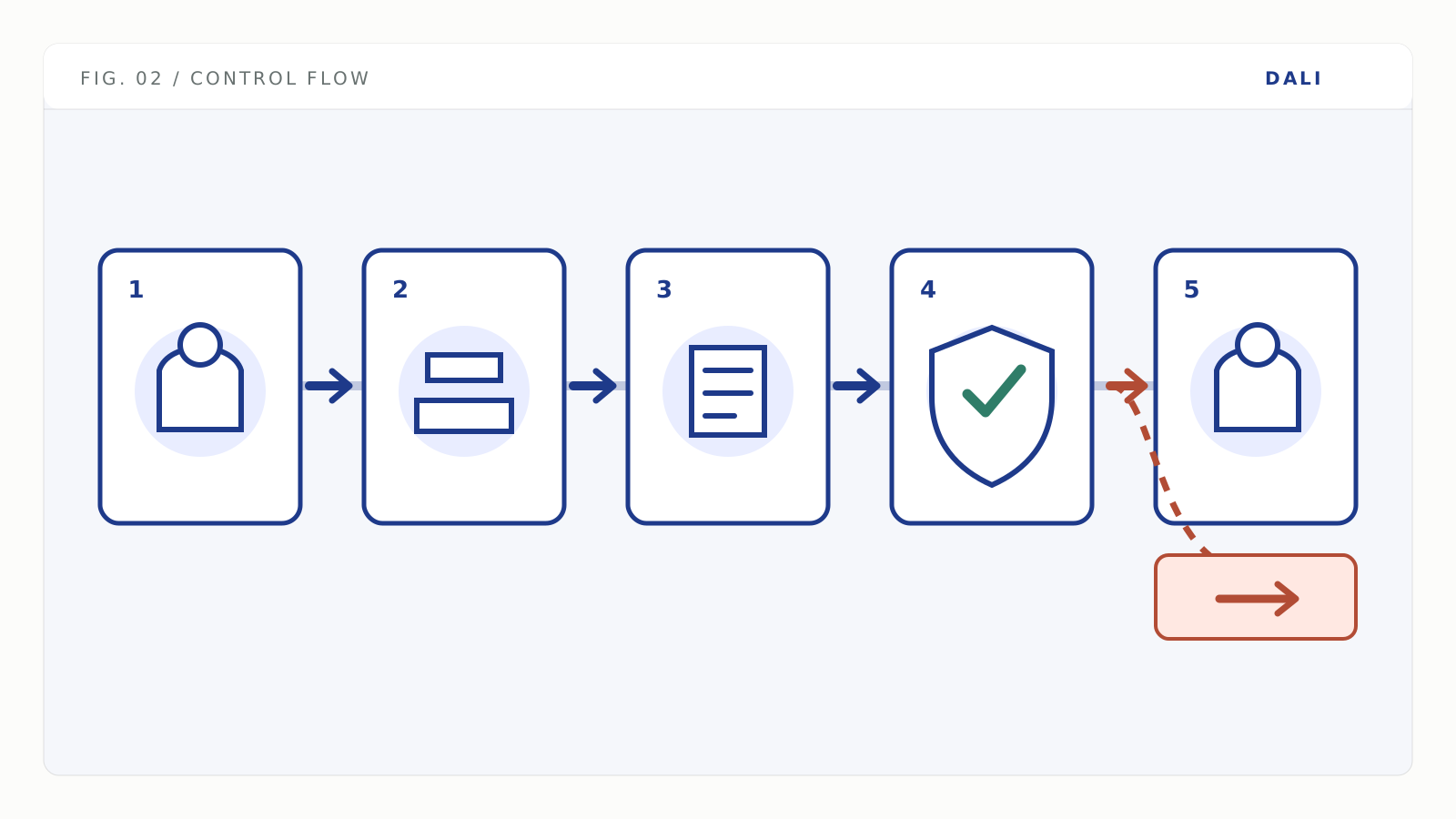
A support agent should have an explicit route for missing evidence, risky actions, and customer requests for a person.
A useful support flow is:
- Verify channel, identity, and available account context.
- Classify the customer's intent and required risk level.
- Retrieve only approved sources and scoped tool data.
- Draft an answer or proposed action.
- Validate policy, permissions, and output format.
- Answer directly if the path is low-risk and supported.
- Pause for approval if the action changes money, identity, access, or an important account state.
- Escalate with structured context when evidence is missing, the customer asks for a person, or a retry limit is reached.
- Record the outcome for evaluation and improvement.
The agent should not hide its uncertainty behind a longer response. If it cannot establish the relevant fact or policy, the correct action is a clean handoff.
Knowledge, tools, and permissions required
Before building the conversation, define the operating inputs.
Knowledge
- Which sources may be used for customer-facing answers?
- Who owns each source?
- How quickly must a policy change become available to the agent?
- What happens when two sources conflict?
- Can the agent show or cite the source to the customer?
Tools
- Which systems can the agent read?
- Which actions can it propose?
- Which actions can it execute?
- Are writes idempotent so a retry cannot create two refunds or two tickets?
- What does each tool return on permission error, timeout, or missing data?
Permissions
- Is identity verified before account-specific data is retrieved?
- Does each integration use a scoped service account?
- Are sensitive fields filtered before model use and logging?
- Is every risky action tied to an approval policy?
- Can an operator disable the action path without taking the entire support channel offline?
NIST's Generative AI Profile frames risk management as an ongoing governance, measurement, and monitoring process rather than a one-time model choice (NIST AI 600-1). That is the right mental model for a support agent whose policies, products, and customer behavior change over time.
How to design the first pilot
Choose one queue or intent family. Do not launch across the entire help center at once.
A strong first pilot has:
- enough recurring volume to produce evaluation cases;
- a written, current source set;
- a clear owner on the support team;
- a manual fallback;
- low-risk initial actions;
- a baseline from the current human process;
- explicit acceptance and stop conditions.
Recommended rollout
- Build an offline evaluation set from representative historical cases.
- Test retrieval, routing, response, refusal, and escalation separately.
- Run in shadow mode on live cases without answering customers.
- Compare agent decisions with real support outcomes.
- Release to one narrow intent with human review.
- Expand only when the evidence stays acceptable across normal and difficult cases.
OpenAI's eval tooling formalizes the idea of a repeatable dataset plus testing criteria (OpenAI Evals). The exact platform is optional. The repeatability is not.
What to measure
Do not declare success from answer volume alone.
| Metric | What it tells you | Guard against |
|---|---|---|
| Supported-answer rate | How often an answer is backed by the required source | Counting fluent but unsupported replies |
| Routing accuracy | Whether the case reaches the right queue | Hiding reassignments after the first route |
| Confirmed resolution | Whether the customer's problem was actually resolved | Treating abandonment as success |
| Reopen rate | Whether the issue returned after apparent resolution | Closing cases too early |
| Human escalation rate | How often the agent transfers control | Optimizing the number without judging escalation quality |
| Handoff completeness | Whether the receiving agent gets the required context | Passing a long summary that omits the key decision |
| Approval rejection rate | How often a proposed action is rejected | Ignoring why reviewers reject it |
| Incident count and severity | Whether the agent caused or amplified harm | Averaging severe events into normal quality metrics |
| Cost per confirmed resolution | Full operating cost for a successful outcome | Looking only at model tokens |
Set thresholds from your baseline, policy, and risk tolerance. There is no honest universal target for every support operation.
For a full evaluation method, see how to evaluate AI agents before go-live. For the event record behind these metrics, see agent observability: logs and traces.
Common failure modes
Automating the wrong queue
A queue with unstable policy or many exceptions is a poor first target even if its volume is high.
Treating the help center as automatically correct
An agent can faithfully repeat a stale or contradictory policy. Source ownership and update cadence are part of the system.
Measuring containment instead of resolution
Keeping a customer away from a human is not success if the answer is wrong or the customer gives up.
Hiding the human path
Customers should be able to request a person. The system also needs its own escalation triggers for missing evidence, repeated failure, sensitive topics, and high-impact actions.
Giving write access too early
A read-only account lookup and a refund tool may sit beside each other in the interface, but they have very different blast radii.
Sending a context-free handoff
If the human must reread the whole conversation and repeat every lookup, the handoff is not complete.
How Dali fits
Dali scopes support pilots around one queue, one owned source set, and explicit action boundaries. The pilot includes evaluation cases, approval and escalation paths, observable runs, and a handoff that the support team can operate.
Relevant product patterns are available in solutions. See solutions for the delivery model.
FAQ
Not necessarily. A chatbot primarily provides a conversation surface. An agent can also retrieve account state, route work, use tools, and take controlled actions inside a workflow. Those extra capabilities require permissions, evaluation, logs, and clear human control.