Agentic AI vs generative AI: content vs action systems
Compare generative content systems with agentic action systems, then see how tools, permissions, memory, evaluation, and human control must change.
Written by Dali
Dali is an AI agent systems studio. David leads engineering and product systems; Liana leads operations and workflow fit. We ship production agents inside tools teams already use.
David Hakobyan · LinkedIn · Dali
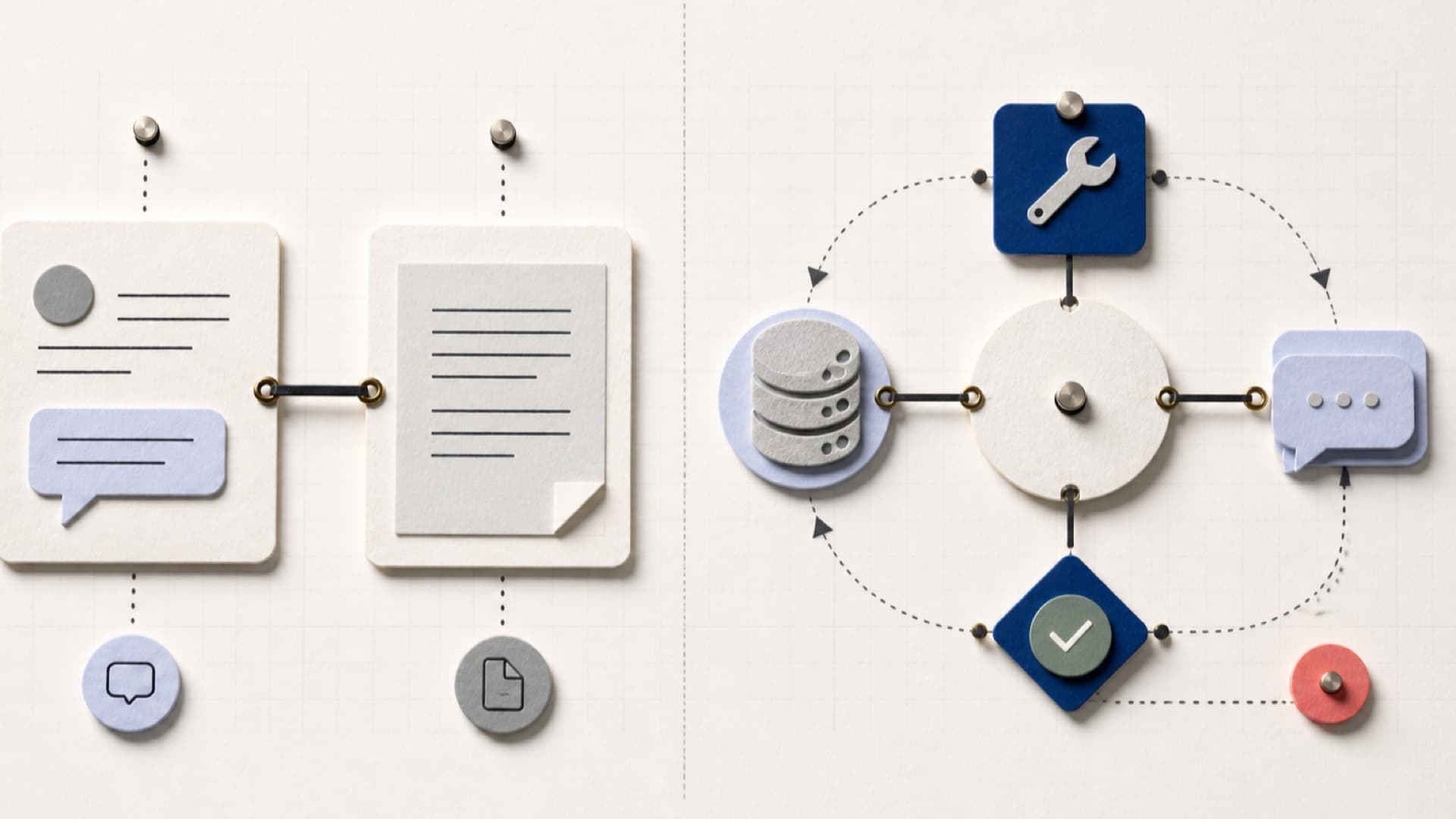
Generative AI produces synthetic content such as text, images, code, or audio in response to a prompt. Agentic AI pursues a goal by planning steps, calling tools, keeping state, and acting in external systems until the work finishes or a safe stop condition fires.
The line is not branding. It is whether the system only returns something a human can review, or whether it can change records, send messages, move money, or trigger workflows without another person retyping the action.
When that line is crossed, control requirements change. You need scoped permissions, memory rules, evaluation of side effects, human gates on irreversible steps, and a named owner who can stop the run. That is the practical difference this article owns.
If you need product labels such as chatbot, copilot, RPA, and agent as buying categories, use the separate taxonomy in AI agent vs chatbot vs copilot vs RPA. This page is about content output versus goal pursuit.
What each term means
Generative AI
In NIST's Generative Artificial Intelligence Profile, generative AI is the class of models that generate derived synthetic content such as images, video, audio, text, and other digital content (NIST AI 600-1).
In product terms, the value is usually the artifact the model returns: a draft email, a summary, an image, a code snippet, or a structured suggestion. The human still decides what to publish, send, or commit.
Google Cloud describes generative AI as focused on creating new content from input prompts, with the model at the center of that value (Google Cloud on agentic AI).
Agentic AI
Google Cloud defines agentic AI as an advanced form of AI focused on autonomous decision-making and action: setting goals, planning, and executing tasks with limited continuous human direction (Google Cloud on agentic AI). Google also describes agentic systems as using generative models as a brain while acting through tools, so the useful production split is content-only output versus goal-driven action under controls.
Google Cloud also defines AI agents as software systems that pursue goals and complete tasks, with reasoning, planning, memory, and a level of autonomy (Google Cloud on AI agents).
OpenAI describes agents as applications that plan, call tools, collaborate across specialists, and keep enough state to complete multi-step work (OpenAI agents guide).
A useful research root for the loop itself is ReAct: interleave reasoning and acting so the system plans, acts, observes, and continues rather than only emitting a final answer (ReAct paper).
Recommendation: treat "agentic" as an architecture claim about goals, tools, and side effects, not as a marketing upgrade of the same chat box.
Content system vs action system
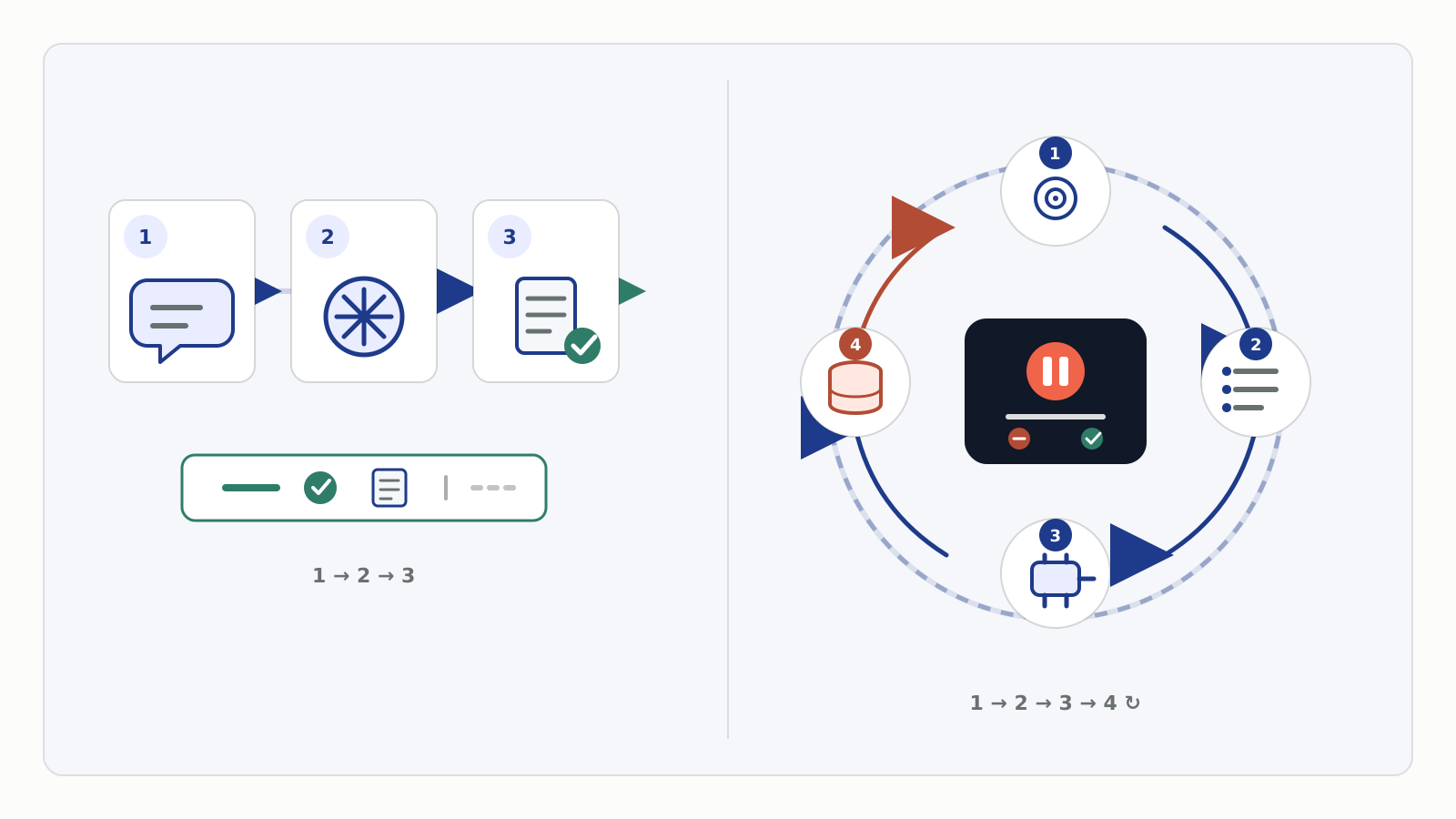
Left: a generative path that produces content for human review. Right: an agentic path that loops through tools and can change external systems, so permissions, memory, evaluation, and human gates matter.
In a content system, the model generates an artifact and stops. Failure is usually wrong, incomplete, or misleading content that a reviewer can still refuse to ship.
In an action system, the model participates in a loop: gather context, plan the next step, call a tool, observe the result, and continue. Tool calling is the mechanical bridge: the model requests a function, the application or platform executes it, and the result returns so the run can continue (OpenAI function calling, Anthropic tool use).
The threshold is external state change. Once the system can write to a CRM, issue a refund, book a slot, post a message, or open a ticket, you are no longer evaluating prose quality alone. You are evaluating whether the right world change happened under the right permission.
Comparison table
| Dimension | Generative AI (content system) | Agentic AI (action system) |
|---|---|---|
| Goal | Produce a useful artifact for a human to use or edit | Complete a multi-step objective in tools and workflows |
| Loop | Prompt in, content out; usually ends after generation | Plan, act through tools, observe, iterate until done or stopped |
| Tools | Optional retrieval or light helpers; side effects are not the product | First-class tool calls that read and write external systems |
| State | Mostly conversation or session context for drafting | Task state, tool results, memory, and durable business records |
| Autonomy | Reactive to each prompt; human drives next step | Variable autonomy within policy; can continue multi-step work |
| Failure consequences | Misleading draft, wasted review time, reputational content risk | Wrong record, wrong payment, wrong message, cascading process damage |
| Evaluation | Quality of content: accuracy, tone, completeness, policy fit | Outcome of the run: correct actions, safe refusals, recovery, cost |
| Human control | Review and edit before publish or send | Approval gates, least-privilege tools, traces, stop switch, named owner |
This table is a decision aid, not a claim that every generative feature is safe or that every agent must be fully autonomous. Many production designs keep generative models inside an agentic loop and still require human approval on high-risk steps (OpenAI guardrails and human review, human-in-the-loop AI agents).
The control delta: what must change
When you move from content to action, the model is no longer the whole product. Controls around tools, identity, memory, and ownership become the product.
Permissions
A draft does not need a service account with write access to production systems. An agent that updates customer records does.
Recommendation: scope each tool to the minimum actions required, prefer separate credentials per integration, and refuse broad admin tokens "because the demo was easier." Buyer-facing security checks belong in AI agent security checklist for buyers and safe tool calling for business agents.
Memory
Generative sessions often keep short chat history so drafting feels coherent. Agentic systems may keep short-term task state, longer-term memory, or retrieved knowledge across steps (Google Cloud on AI agents).
That raises retention, access, and freshness questions. Storing the wrong fact is no longer only a wording problem if the agent later acts on it. For grounding and memory design, see RAG, memory, and grounding for agents. For the complete runtime assembly and expiry lifecycle, see context engineering for AI agents.
External state changes
Content systems leave the world unchanged until a human acts. Agentic systems can mutate tickets, invoices, calendars, CRM fields, and channels.
Recommendation: classify every tool as read-only, reversible write, or irreversible write, and gate irreversible writes until evidence supports loosening. Idempotent writes and explicit confirmation for high-impact actions are production patterns, not optional polish.
Evaluation and risk framing
NIST's AI Risk Management Framework is voluntary guidance organized around Govern, Map, Measure, and Manage for AI systems across their lifecycle (NIST AI RMF). The Generative AI Profile highlights risks that content systems already face, including confabulation (confidently wrong content) and human-AI configuration issues such as over-reliance and automation bias (NIST AI 600-1).
Those content risks do not disappear in agentic systems. They compound when a confabulated claim becomes a tool argument.
Recommendation: evaluate generative quality and action outcomes separately. A fluent reply that calls the wrong tool is still a failed run.
Human control
Generative control is usually "do not ship until someone reads it." Agentic control is "do not execute the risky step until policy or a person allows it," plus traces that show what the system saw, decided, and did (OpenAI agents guide).
Full unattended autonomy is not a default business goal. Start with assisted or gated autonomy and only widen when evaluation and ownership support it. Architecture detail for production systems lives in what is a production AI agent.
Failure modes
Generative failure modes
- Confabulation. The model invents facts, citations, or policy language with high confidence (NIST AI 600-1).
- Policy-tone miss. Content is fluent but violates brand, legal, or channel rules.
- Over-reliance. Reviewers stop checking because the draft "sounds right," a human-AI configuration risk called out in the GenAI Profile.
These failures hurt when content is published or trusted without review. They are still usually recoverable by not publishing.
Agentic failure modes
- Wrong tool, right confidence. The model chooses an action that fits the wording of the goal but not the business rule.
- Permission overreach. Broad credentials turn a local mistake into a wide blast radius.
- Stale or poisoned context. Bad memory or ungrounded retrieval steers later tool calls.
- Loop thrash. Retries without idempotency duplicate charges, messages, or tickets.
- Silent side effects. Actions succeed in systems of record while the chat surface shows a vague success message.
- Missing stop switch. Nobody can halt a misbehaving run quickly.
For operational patterns behind these failures, see production agent failure modes and demo vs production.
Hypothetical example: a generative assistant drafts a refund email for a human agent to send. An agentic path that can issue the refund through a payment tool needs different controls even if the model family is the same.
When generative is enough, and when agentic is warranted
Stay generative when the job is draft, summarize, rewrite, classify, or suggest, and a human remains the only actor who changes systems of record.
Move toward agentic design when the job is multi-step work across tools, the cost of manual re-entry is high, and you can define success as a completed outcome with observable steps.
Do not add tools just because the model can call them. If the process is unclear, rare, highly judgment-heavy, or legally sensitive without a gate, prefer content assistance or a simpler automation path. See when not to use AI agents.
Recommendation: pilot agentic systems on one narrow workflow with explicit tool contracts, a human owner, and gated irreversible actions. Expand only after traces and evaluation show the run is trustworthy under real inputs.
FAQ
Often the model is generative, and the agentic part is the surrounding loop: goals, tool execution, state, and stop conditions ([Google Cloud on agentic AI](https://cloud.google.com/discover/what-is-agentic-ai), [OpenAI agents guide](https://developers.openai.com/api/docs/guides/agents)). Tools without a goal loop and without state are closer to function calling bolted onto a chat product than to a production action system.